
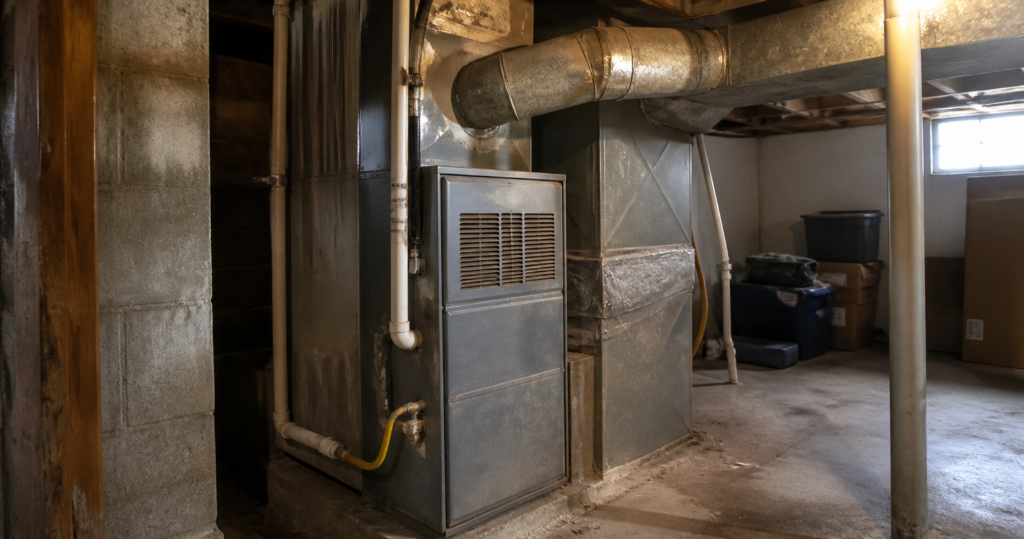
When you are preparing to sell a house in Wisconsin or Illinois, the HVAC system is one of the first things a serious buyer is going to ask about and one of the first things a home inspector is going to put under a microscope. In the Midwest, where winters run hard and summers bring plenty of humidity, heating and cooling are not optional amenities. They are core systems. Buyers know it, and they price their offers accordingly.
The good news is that you do not need a brand-new system to sell your home. You do need to understand what you have, what condition it is in, and what a buyer is likely to do with that information. Here is how to work through that assessment before you list.
Start With the Age of the System
Age is the first number anyone is going to ask about, so find it before they do. The manufacture date for a furnace or central air conditioner is almost always printed on the data plate, usually on the inside of the cabinet door or on the side of the unit. If it is not obvious, the serial number can often be decoded using the manufacturer’s website or a quick search.
General life expectancy benchmarks for Midwest homes:
- Gas furnaces: 15 to 20 years under normal use. In Wisconsin and Illinois, furnaces run hard from October through April. A furnace at 18 years old with no service history is going to raise flags.
- Central air conditioners: 12 to 17 years. Units that have run through a lot of humid Illinois or Wisconsin summers without maintenance tend to land at the lower end of that range.
- Heat pumps: 10 to 15 years, though performance in harsh Midwest winters can compress that timeline if the unit was not spec’d for low temperatures.
- Boilers: 20 to 30 years, longer than forced-air systems, but age still matters. An older boiler with corroded components or a history of leaks will come up in inspection.
If your system is within five years of the end of its expected life, plan for that conversation with buyers. If it is past that window, plan for a harder one.
Look at the Service History
A documented maintenance record carries real weight with buyers and inspectors. If you have records of annual tune-ups, filter changes, and any repairs, gather them. Buyers and their inspectors respond to documentation. It demonstrates that the system has been managed, not ignored.
If you do not have records but believe the system has been serviced, call the HVAC company you have used and ask them to pull any history they have on file. Many local HVAC companies in Wisconsin and Illinois keep service records going back several years.
If there is no service history and the system is more than ten years old, schedule a tune-up before listing. The cost is modest, typically between $80 and $150 for a standard furnace or AC inspection in this region. What you get back is a technician’s written assessment of the system’s current condition, which you can share with buyers, and any small issues caught before inspection day.
Run the System and Pay Attention
Do not wait for an inspector to be the first one to turn the heat on in October. Run your furnace before you list, even if it is early fall. Listen for anything unusual: banging, rattling, extended cycling, or a furnace that runs but does not seem to produce adequate heat. Check that air is moving from every register. Walk the house while the system runs and note any rooms that feel significantly different from others.
Do the same with your central air when temperatures allow. Watch for the unit struggling to reach the set temperature, ice forming on the refrigerant lines, or the condenser making grinding or squealing sounds. These are not just inspection concerns. They are signals that something is already failing.
Also check the air filter. A severely clogged filter tells an inspector that the system has been neglected. Replacing a filter before a showing costs a few dollars and takes five minutes. There is no reason not to do it.
Understand What Inspectors Look For in This Climate
Home inspectors in Wisconsin and Illinois are trained to evaluate HVAC systems with Midwest conditions in mind. A few things they consistently flag:
- Heat exchanger cracks in furnaces. A cracked heat exchanger is a carbon monoxide risk. Inspectors test for this. If a crack is found, buyers and their agents treat it as a serious defect, not a negotiating chip. Replacement of the heat exchanger typically runs $1,500 to $3,500 depending on the furnace and the unit may not be cost-effective to repair if it is already old.
- Inadequate furnace sizing. A furnace that is too small for the square footage of the house will run continuously in Wisconsin winters and still fall short. Inspectors note this. Buyers factor it in.
- Ductwork condition. Leaking, disconnected, or poorly insulated ducts reduce efficiency significantly. In older Wisconsin and Illinois homes, it is common to find original ductwork that has never been sealed or updated. Inspectors photograph it. Buyers ask about it.
- Refrigerant levels in AC units. Low refrigerant usually means a leak somewhere in the system. Inspectors flag low charge as a deficiency. Recharging without finding the leak is a temporary fix that buyers and their agents recognize as temporary.
- Humidifier condition. Whole-house humidifiers are common in Midwest homes and frequently neglected. A humidifier with a failed water panel, a stuck float, or a corroded drain line will be noted in the inspection report. Replacing a water panel is inexpensive. Leaving a failed humidifier in place signals deferred maintenance more broadly.
- Carbon monoxide detectors and furnace venting. Inspectors check that CO detectors are present and functional and that furnace flue venting is properly connected and unobstructed. Missing or improper venting is a red flag that stops transactions.
Get a Second Opinion Before You List
If your system is aging or you have concerns about what an inspector might find, consider paying for a pre-listing HVAC inspection. This is different from a tune-up. You are asking a licensed HVAC technician to evaluate the system the same way a home inspector would, with specific attention to anything that is likely to become a transaction issue.
What this does for you is create options. If the technician finds a significant problem, you can decide before a buyer is involved whether to repair it, disclose it and adjust your price, or pursue a different sale path altogether. Making that decision on your timeline, with no buyer in the room, is almost always better than making it under contract pressure when a buyer is already using the inspection report as leverage.
What It Costs to Repair or Replace
Here is a realistic range for common HVAC work in Wisconsin and Illinois as of mid-2026:
- Furnace replacement: $3,500 to $7,500 installed for a mid-efficiency gas furnace. High-efficiency units run higher.
- Central AC replacement: $4,000 to $8,000 installed, depending on the size of the unit and any needed line set or electrical work.
- Heat exchanger replacement: $1,500 to $3,500, often not cost-effective on an older furnace.
- Refrigerant leak repair and recharge: $300 to $1,500 depending on where the leak is and how much refrigerant is needed.
- Duct sealing: $1,000 to $3,000 for a professional duct sealing service on an average-sized home.
- Tune-up and inspection: $80 to $150, almost always money well spent before listing.
These numbers matter because they help you evaluate whether a repair makes financial sense relative to what it does for your sale price and your negotiating position. A $5,500 furnace replacement on a house where you are already getting strong offers is a different calculation than the same replacement on a house where buyers are already hesitant.
Disclosure Requirements in Wisconsin and Illinois
Both Wisconsin and Illinois require sellers to disclose known material defects, and HVAC condition falls squarely in that category. Wisconsin’s Real Estate Condition Report asks sellers to disclose defects in the heating and cooling systems. Illinois’s Residential Real Property Disclosure Report asks similar questions.
Trying to conceal a known HVAC problem is not a viable strategy. Inspectors find most of them. When they do, and it becomes clear the seller was aware, the transaction often falls apart and the legal exposure gets worse. Disclose what you know. Let buyers make informed decisions.
If the Repairs Feel Like Too Much to Take On
Not every seller is in a position to spend $5,000 or $7,000 on an HVAC system before a sale. Some sellers are working against a hard timeline. Some inherited a property they never maintained. Some are managing a dozen other things and the idea of coordinating contractors, waiting on permits, and then hoping the inspection goes well is more than they want to handle.
That is a legitimate position. Selling a house with a known HVAC issue does not mean you are stuck. It means you need a buyer who can price it in and move forward without requiring you to fix it first.
At Royal Real Estate Solutions, we work with sellers across all of Wisconsin and Illinois. We buy houses as-is. HVAC systems that are aging, failing, or already dead are not deal-breakers for us. We factor in what the system is and what it will take to address it, and we make an offer based on that reality rather than asking you to fix it and then come back.
If you have gone through this assessment and the repairs feel like more than you want to take on, give us a call. Tell us what is going on with the property. We will give you a straight answer about what we can do, and if we are not the right fit, we will tell you that and point you somewhere that is.